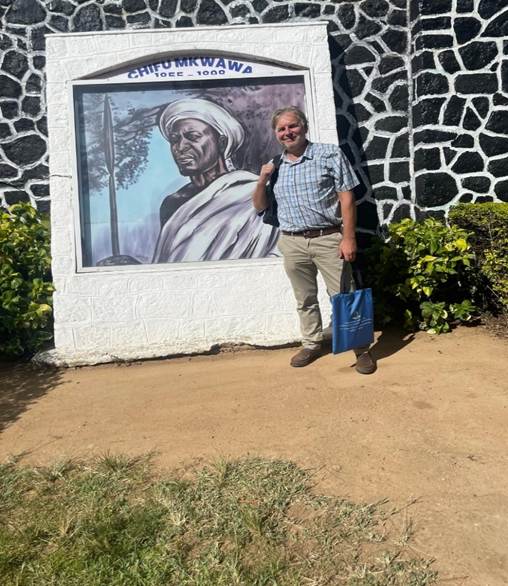
Visiting Mkwawa University College of Education, Iringa, Tanzania
I’m still at it. Sorry about the long gap since the last blog, I’ve been busy collecting data… From my earlier attempts at blogging, you may recall that I’m doing a PhD with a focus on the UN’s Sustainable Development Goal 4.i – to ensure universal ‘access to quality education’ to the age of 16 – a commitment made by Tanzania and most other countries in 2015. Ten years on over three million children do not complete secondary school in Tanzania and many schools have significant issues with quality.
In PhD Year 1 we learnt how to do research and the importance of defining things like ‘knowledge’ and your understanding of ‘reality’. Pretty basic stuff, added to which in my case was the challenge of re-acquainting myself with the mental head space of academia – a world I’d last visited in 1989 – as well as getting stuck into my desk research on education in Tanzania. The culmination of PhD Year 1 is to submit (and pass a viva on) a 10k word Research Proposal outlining what you’re actually going to do, how you’re going to do it, what your key ‘research questions’ are and how you’re going to contribute to ‘knowledge’. You also have to get through the prickly process of ‘ethical approval’ (Sussex University) and for me the even more prickly process of ‘foreign research approval’ (the Tanzanian government).
In PhD Year 2 you can get on with it – this has meant three field research trips to Tanzania spanning five months, the last of which ends tomorrow.
My first trip ‘approaching the field’ (research not yet approved) involved lots of informal meetings and visits to schools and some serious networking to get the formal stuff in place. On the second trip I conducted 38 one-to-one semi-structured interviews with senior stakeholders in Tanzania’s education system across five diverse regions. These were (audio) recorded, then transcribed and coded and initial findings and analysis reported. For this third trip I organised a forum in each of the five regions, attended by participants from the initial interviews. I also made presentations at the two Ministries which run education in Tanzania – the Ministry of Education, Science and Technology and the Ministry of Regional and Local Government. The purpose of this third trip was to share my initial findings and analysis – for confirmation or challenge – and to move the data collection into new areas.
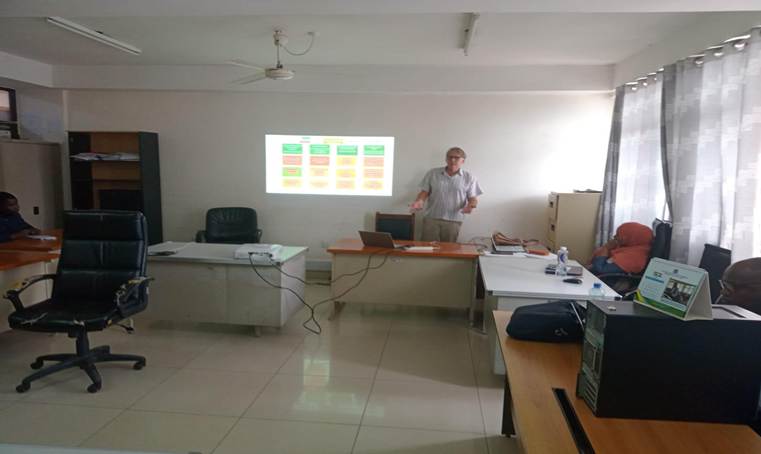
Presenting my findings at one of the Ministries
For the forums, which lasted 3 hours, I facilitated interactive discussions by laying out a series of coloured cards on the table. This approach proved to be a helpful way of overcoming some of the linguistic and conceptual challenges. For the Ministry meetings, just I hour, I used a more conventional power point / discussion approach. Both were structured as follows –
- Present initial findings on the ‘progress’ (green cards) and ‘constraints’ (red cards) to ‘access to quality education’ – discuss
- Present my analysis of the above (in short – that the scale and connectivity of the ‘constraints’ requires a system-wide response of similar scale and connectivity) – discuss
- Present initial findings on the ‘operational effectiveness’ of the education system (+ green cards / – red cards) – discuss (there are a lot of red cards on the table by this point)
- Introduce challenging new questions regarding the education system’s ‘critical characteristics’ (blue cards) – discuss
- An activity to transform the system’s ‘critical characteristics’ (blue cards) to the point that many of the ‘constraints’ (red cards) can be taken off the table
My initial findings received a good deal more challenge at the Ministry meetings than they did at the forums. The civil servants at the Ministries were perhaps less accustomed to hearing the kind of findings that I was reporting on and a good deal of the time was spent discussing my research methods and reasoning. It was fascinating to hear their responses and to engage in some lively debate with them about the extent of the challenges schools are facing and the operational constraints that I have identified within the education system itself. Useful data was generated from both the process and the outcomes. We didn’t have much time to discuss the ‘critical characteristics’ of the system, but these characteristics – tentatively identified by me – did form the bulk of the discussions that were had at the five longer and more in-depth regional forums. I was really pleased with how these went – of the 38 initial participants I had interviewed 23 took part. There were some issues raised with regards to my findings and analysis, but broadly speaking participants aligned with what I was reporting back to them and the discussions were able to move on to the system’s ‘characteristics’, exploring things like historical legacy, the size and complexity of the structure, power relations, political appointments, Nyerere’s concept of ‘self-reliance’, trust and fear and the extent of decentralisation – and much valuable data was produced. The forums were fascinating, not just for the quality of the contributions and the commitment of those taking part, but also for the fact that many of the participants hadn’t discussed such matters before, nor had they been involved in such a ‘group interactive’ process before and few had previously had the opportunity to meet or discuss things with the range of different role holders that were gathered around the table each time.
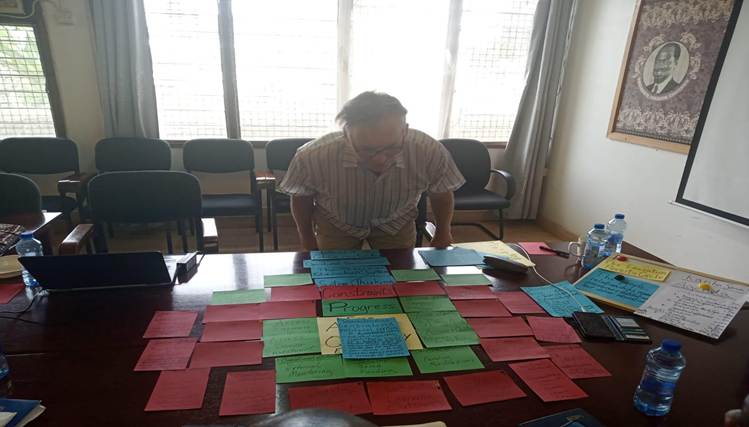
At the forum in Morogoro – putting my cards on the table
My (formal) interviews, forums and meetings have involved 51 people (25 of whom came twice). I really appreciative their contributions and I am now the proud possessor of 50+ hrs of recorded research dialogue! In addition to this my field research has generated plenty of ‘observations’ (my second research ‘tool’) in the form of 50k+ words recorded in my Research Journal, quite a bit of which is unrepeatable, but some useful things as well, not least my growing familiarity with the cultural phenomena of Tanzania that is embedded in the education system. ‘Observations’ are considered legitimate data in this kind of qualitative ‘exploratory case study’ research and I have plenty to draw on if / when it becomes relevant to my thesis. I have also been collecting documents (my third research ‘tool’) – some skimmed and some hardly looked at yet. These are all the latest govt produced papers on education, along with recent (I)NGO / Donor Institution monitoring reports and some media articles. I need to work more on these to try to find some reportable features and if possible, consistency – especially re key data and statistics – in what is at times a confusing and over-loaded ‘information’ environment. So – I’ve collected a lot of data and now it’s a case of re-organising it to accommodate the new stuff, coding it all into themes (vertical and horizontal) and reporting the full findings.
And then the most interesting bit can start – the analysis of the findings and finally the conclusions (new knowledge!) and recommendations, which must of course loop back to the original title of the thesis and the key ‘research questions’ that I started out with. Only 80,000 words to go – as PhD Year 3 beckons…

 Back to school Tanzania
Leave a reply to johnballatt Cancel reply